
805 words/3.5-minute read
There’s a question I hear from leaders more than any other right now — and it’s not usually asked out loud:
“We’ve invested in AI. So why aren’t we seeing the results we expected?”
Sometimes it shows up as frustration. Sometimes as confusion. And sometimes as a quiet embarrassment — because no one wants to admit that the tools they championed aren’t delivering the returns they promised.
Here’s what I’ve learned from working inside these conversations: the technology is rarely the problem.
The strategy around it usually is.
The Misconception That’s Costing You
Most organizations approach AI as a tool problem.
They evaluate platforms. They run pilots. They bring in vendors. They check boxes on a procurement list.
And then they wait for transformation to happen.
It doesn’t.
Not because the tools aren’t capable — but because tools don’t transform organizations. Aligned people, clear processes, and intentional strategy do.
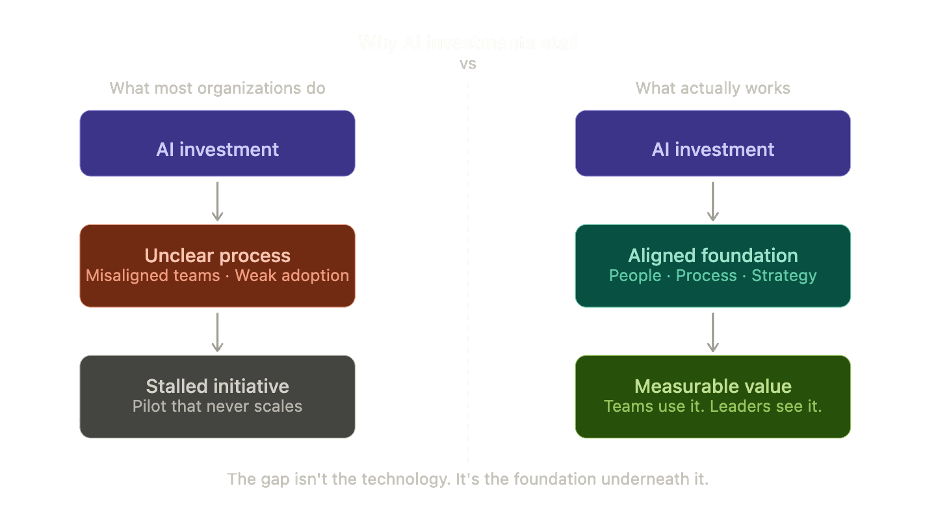
When AI is introduced without that foundation, something predictable happens: teams hesitate to adopt it, leaders struggle to get buy-in, and the initiative becomes a “pilot” that never fully scales. Eventually, someone has to explain why a significant investment hasn’t produced a significant return.
That’s not a technology failure. That’s a strategy gap.
What Leaders Are Actually Asking (When You Dig Deeper)
In the discovery conversations I have with executives and senior leaders, the real questions are never about features or platforms. They’re asking things like:
• How do we get better outcomes without burning out our teams?
• How do we actually use the tools we’ve already invested in?
• How do we get people to stop resisting and start adopting?
• Why does every AI initiative feel like it’s solving the wrong problem?
These are not technology questions. They are strategy, culture, and change management questions. And they require a very different kind of answer than a software demo can provide.
What the Gap Actually Looks Like
Here’s what I see consistently across industries — and it doesn’t matter whether we’re talking about a healthcare system, a financial services firm, or a construction company:
AI gets deployed on top of broken or unclear processes.
If your team doesn’t have shared clarity on how decisions get made, AI will automate the confusion — faster. If your organization has communication gaps, AI tools will produce outputs that nobody fully trusts or uses. If people don’t understand why they’re using a tool, they’ll use it inconsistently, incorrectly, or not at all.
"AI doesn't fix broken processes. It amplifies them."
That’s not cynicism — that’s the pattern I’ve watched play out over and over again. And it’s the reason the organizations getting real results from AI aren’t starting with the tool. They’re starting with the work.
The Shift That Changes Everything
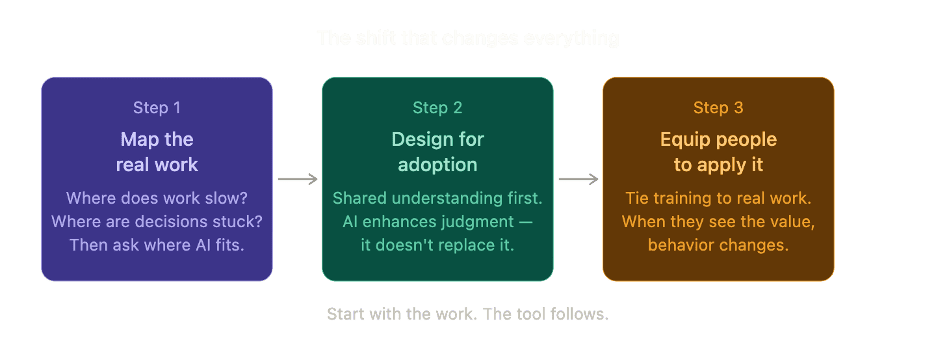
The leaders seeing genuine AI value have made one important shift: they stopped asking “What can AI do?” and started asking “What are we actually trying to accomplish?”
From there, the work looks like this:
Map the real work. Before introducing any new tool, understand where work slows down, where decisions get stuck, and where teams are duplicating effort. Then — and only then — ask where AI can support.
Design for adoption, not just efficiency. AI can make work faster. But speed without alignment creates chaos. The teams that succeed focus on shared understanding before automation — AI as an enhancer of human judgment, not a replacement for it.
Equip people to apply it — not just use it. Adoption stalls when training is theoretical. The difference is giving people practical application tied to their actual work. When someone can see how a tool immediately improves something they’re responsible for, that’s when behavior actually changes.
This Is the Work That Actually Moves the Needle
At Champagne Collaborations, this is where we spend most of our time — not in the technology conversation, but in the one underneath it.
What does your team actually need to understand before this tool makes sense? Where does the process need to be cleaner before automation helps rather than hurts? What would it take for your people to genuinely adopt this — not just comply with it?
Those questions live at the intersection of strategy, process, and people. And that’s exactly where we work.
It’s not glamorous work. It doesn’t come with a flashy demo or a feature comparison chart. But it’s the work that turns AI from a line item on a budget into something your teams actually use — and your leadership can actually point to.
A Question Worth Sitting With
If your AI initiatives feel fragmented, stalled, or stuck in pilot mode, here’s the question I’d ask you to consider:
"Is the problem the tool — or the foundation underneath it?"
Because when the foundation is right — when process, people, and technology are aligned — AI stops being an overhead cost and starts becoming a genuine competitive advantage.
That’s when the investment finally delivers what you expected.
View our article sharing and reuse policy here